The historical records of a family can sometimes reveal more than names, dates, and relationships. Newspaper articles, census records, and obituaries can offer glimpses into private struggles that might otherwise have remained hidden. The story of Harold Wray Driehorst and Annabelle Fuller Driehorst is one such case.
Over the years, newspaper accounts documented financial hardship, repeated childhood injuries, marital separation, and a family that eventually became scattered among other households. Although the surviving records do not provide all the answers, they raise difficult questions about what life was like for Harold, Annabelle, and their six children.
A Young Marriage and an Early Separation
Harold Wray Driehorst was born on April 13, 1903, in Washington County, Pennsylvania.1 He married Annabelle Fuller in 1926 in Ohio County, West Virginia.2 Annabelle was born on March 1, 1910, in Cecil, Pennsylvania.3 A marriage announcement published in The Daily News of Canonsburg, Pennsylvania, described a quiet wedding at the home of a pastor.
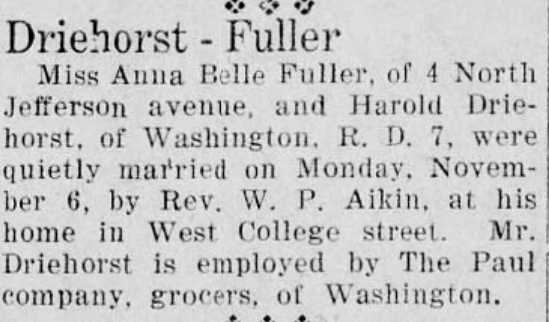
The marriage soon encountered difficulties. In August 1927, Harold was arrested and jailed on a charge of desertion and nonsupport.5 Annabelle was pregnant at the time, and the charge suggests that there were concerns about Harold’s responsibility for supporting his wife.
Their son, Walter Harold Driehorst, was born in September 1927.6
The 1930 census found Harold living with his parents, Wray Sanford and Margaret Stephens Driehorst, in Washington, Pennsylvania.7 Neither Annabelle nor Walter was enumerated in the household. Annabelle was also absent from the household of her father, Joseph Fuller, in Washington County. Her mother, Mary Hollanbeck Fuller, had died in 1920.8
Where Annabelle and Walter were living at the time remains uncertain. The census records leave an early gap in the family’s history, and it is unclear whether Harold and Annabelle were living apart permanently or temporarily.
Despite these early difficulties, the couple went on to have five more children during the 1930s: Robert in 1930, Dorothy in 1931, James in 1932, Glenn in 1934, and Thomas in 1937.
The decade that followed appears to have been exceptionally difficult for the growing family.
Injuries, Unemployment, and Hardship in Camden
By the 1930s, Harold and Annabelle were living in Camden, New Jersey. Newspaper reports document several incidents in which their children required medical attention.
In 1936, James suffered a head injury after a fall.9 Three years later, in 1939, both Glenn and Thomas were injured. Glenn suffered a cut to an eye10, while Thomas fractured his arm.11
The circumstances surrounding these accidents are not fully documented. Childhood injuries were not unusual, particularly in an era when children often spent considerable time playing outdoors. However, the number of reported injuries within this family, considered alongside the other difficulties that emerge from the records, is noteworthy.
In 1939, Annabelle placed an advertisement in a Camden newspaper asking someone to donate a baby buggy. Thomas was approximately two years old and had a broken bone. Annabelle wanted to take him outside but had no way to carry him.
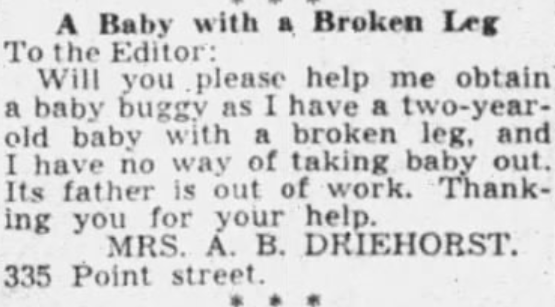
The advertisement offers a small but revealing glimpse into the family’s circumstances. Annabelle was caring for several children, one of whom was injured, and apparently lacked even the basic equipment needed to transport him comfortably. Harold was also out of work during this period.
The family’s difficulties continued into the following year. In 1940, Thomas suffered another injury, this time a fractured shoulder.13
The newspaper reports document a series of injuries affecting several of the Driehorst children over a period of years. They do not establish how those injuries occurred beyond the explanations reported in the articles, nor do they establish that any member of the household deliberately caused them. Still, these repeated medical incidents are part of the family’s documented history and deserve consideration alongside the other challenges they faced.
Financial instability, a growing household, and the demands of caring for six children would have placed considerable strain on the family. The records suggest that the Driehorsts were struggling, but the full nature of their home life remains unknown.
Harold’s Desperate Letter to the Editor
By 1940, the Driehorst family was still living in Camden. Their youngest child, Charles F. Driehorst, had been born in February of that year.14
In May, Harold wrote a letter to the editor of the Evening Courier describing what he considered intolerable housing conditions.15
According to Harold, he had moved his family from Schenectady, New York, to Camden in 1930. At the time, he claimed to have a good job and money in the bank. He did not explain every detail of the financial setback that followed, but he stated that it eventually forced him to apply for public relief.
On April 15, 1940, the family was evicted from its residence. Harold complained that their furniture had been placed on the street against his wishes. Relief workers subsequently transported the furniture to another residence and instructed the family to live there. According to Harold, much of their furniture was stolen from that location.
The replacement house was, in his account, scarcely fit for habitation.
Harold reported that the Department of Health had condemned the property. There was no running water for either the toilet or washing. The doors would not close or lock properly, downstairs windows were broken, and the cellar windows and frames were missing. The house had no electricity or gas. The chimney was in danger of falling, the rear of the residence threatened to cave in, and the roof leaked while plaster fell from the walls and ceilings.
The smell was so terrible, Harold wrote, that it was enough “to make a goat sick.”
He claimed to have spent considerable time searching the streets of Camden for another suitable residence. His letter was an appeal for the housing authority to intervene and explain what assistance might be available to a family in his situation.
Whether the housing authority responded or the family was able to secure better accommodations is not known.
Harold’s letter is an important primary source because it provides his own account of the family’s housing crisis. It also illustrates the instability that accompanied their financial troubles. At the same time, it represents Harold’s perspective on events. The letter tells us how he described his circumstances publicly, but it cannot tell us everything about the experiences of Annabelle or the children.
Annabelle Leaves, and Harold Searches for His Wife
By 1941, the family’s difficulties had apparently extended beyond finances and housing.
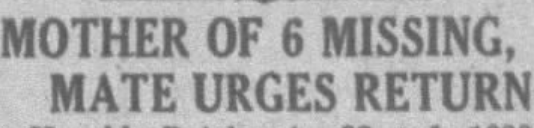
A newspaper article reported that Harold had filed a missing-person report for Annabelle. According to the article, Harold claimed that his wife had been friendly with another man for several months. He maintained that he was doing the best he could for her and said he wanted her to return home.
The article also reported that the children were crying for their mother and asking when she would come back.
Annabelle’s reasons for leaving are not established by the account. Harold’s allegations about another man reflect his version of events, and the newspaper report does not provide Annabelle’s perspective.
Nevertheless, her departure marks another significant moment in the family’s history. Whether she left temporarily or intended to end the marriage, the incident suggests that the household was experiencing serious personal difficulties in addition to its financial problems.
It is tempting to wonder what prompted Annabelle to leave. Was the family’s economic situation simply overwhelming? Had the strain of raising six children under such difficult circumstances become too much? Were there deeper problems within the marriage that the surviving newspaper accounts never revealed?
The possibility of an unhappy or even unsafe home life cannot be ruled out. However, the records available here do not establish that Harold was abusive, and they do not explain why Annabelle left. Her own account would be essential to understanding the circumstances more fully.
There is another troubling aspect to consider. The newspaper reports document repeated injuries among the children during the preceding years. Those injuries, combined with Annabelle’s departure and the family’s eventual separation, raise questions about the children’s home environment. They do not, on their own, prove that the injuries resulted from abuse.
The distinction is important. Historical records can reveal patterns that deserve further investigation, but they do not always provide enough evidence to explain those patterns conclusively.
Financial hardship was undoubtedly another source of stress. By 1941, Harold had experienced unemployment, eviction, and the loss of household possessions. He was attempting to support a large family while navigating public assistance and unstable housing. Whatever the nature of the marital difficulties, these circumstances would have made an already complicated situation more difficult.
A Family in Financial Distress
The family’s financial problems continued into 1941. That year, Harold published a notice in a Camden newspaper stating that he would no longer be responsible for debts unless he had personally contracted them.17
Such notices were sometimes used to disclaim responsibility for debts incurred by another person, including a spouse. Without additional documentation, it is not possible to determine the precise reason for Harold’s notice or to conclude that it was related to bankruptcy.
Taken together, the housing complaint, unemployment, public assistance, and debt notice indicate that the Driehorsts experienced significant financial instability during these years.
The family’s difficulties were not limited to a single bad month or one unfortunate event. The records show problems extending across several years, during which the children were growing up and the family was repeatedly confronted with injuries, housing concerns, and marital uncertainty.
What the records cannot tell us is how each family member experienced these events. Harold’s letter reveals his frustration with public assistance and housing conditions. The report about Annabelle’s departure gives us Harold’s account of a marriage in trouble. The children’s medical reports document injuries but do not reveal their thoughts or feelings.
The family’s story is therefore incomplete, even though the surviving records provide a substantial amount of information.
The Children Become State Wards
By 1949, the Driehorst children, with the exception of Charles, were living with Mr. and Mrs. Reginald Bennett outside Camden.
During this period, Thomas suffered severe burns in an incident involving a fire while he and his brothers were playing with it. According to the account, Thomas did not alert the Bennetts for approximately 24 hours. The Bennetts eventually took him to the hospital for medical treatment.18
The reason for the delay in seeking help is not clear from the information available. Nor does the account establish why Thomas waited to tell the adults about his injuries. The incident nevertheless adds another difficult episode to the family’s history.
The 1950 census provides an especially significant piece of evidence. The oldest Driehorst children were enumerated in the Bennett household, where their relationship to the head of the household was recorded as “state ward.”19 Charles, the youngest, was living with Catherine Duble and was also listed as a state ward.20
This designation indicates that the children were recorded as wards of the state rather than as members of a conventional family household. It raises important questions about the arrangements that led to their placement with other adults and whether public authorities were involved in their care.
The census does not, by itself, explain why the children became state wards, when the arrangement began, or what relationship they maintained with Harold and Annabelle.
Still, the circumstances are striking. Less than a decade after Harold publicly appealed for help with the family’s housing crisis, the children were living in other households under the designation of state wards.
It is difficult to know exactly what led to this outcome. The family’s financial instability, the apparent marital breakdown, and the children’s changing living arrangements may all have played a role, but further records would be needed to establish the reasons.
The Lives of Harold and Annabelle’s Children
Despite the difficult circumstances documented during their childhoods, the Driehorst children went on to establish lives of their own. Their later records provide glimpses of their occupations, military service, marriages, and families.
Walter Harold Driehorst (1927–1975)
Walter was born in September 1927, shortly after Harold’s arrest on the charge of desertion and nonsupport. He enlisted in the U.S. Army on August 19, 1952, and served until July 7, 1954.21 He received the Combat Medical Badge for his service during the Korean War.22
In 1955, Walter married Margarett Moffa. They had three children: Thomas, Elizabeth, and Mary Ann.23 Walter died in 1975 at the age of 48 and was buried in Berlin Cemetery in New Jersey, in an unmarked grave.24
Robert Driehorst (1930–1955)
Robert registered for the draft on November 9, 1950. At the time, he was working as a stock farmer for Reginald Bennett, in whose household several of the Driehorst children had been living.25
Robert died at age 25 in 1955 in an automobile accident. He was buried in an unmarked grave in Atco, New Jersey. Notably, Harold was not mentioned in Robert’s obituary.26
Dorothy Driehorst Dean (1931–2005)
Dorothy married Harvey Allen Dean in 1956.27 They had three children: Harvey, Wayne, and Theodore. Dorothy died in 2005 at the age of 74 and was buried in First Baptist Cemetery in Cape May, New Jersey.28
James Driehorst (1932–1995)
James registered for the draft on February 26, 1951, while working as a farmhand for Reginald Bennett.29 He later became the father of one son, James, and three daughters, Cathy, Terri, and Diane.
James died in 1995 at the age of 62 and was buried in Gate of Heaven Cemetery in Camden County, New Jersey.30
Glenn Driehorst (1934–1989)
Glenn registered for the draft on February 18, 1953, and was working as a farmhand.31 He died in 1989 at the age of 55.32
Thomas Driehorst
Thomas registered for the draft on February 21, 1956, and served in the National Guard. His draft registration noted scars on both legs, possibly related to the burns he suffered as a child.33
Thomas later worked as a bulldozer operator. In 1961, he married Kay Whitman.34
Charles F. Driehorst
Charles was born in February 1940, the youngest of Harold and Annabelle’s six children. Unlike his older siblings, Charles was living with Catherine Duble at the time of the 1950 census.35
Charles eventually moved to Kentucky and also spent time in Florida. It was among his children’s generation that the family surname began appearing as Driehurst rather than Driehorst.
The Deaths of Harold and Annabelle
Harold Driehorst died in 1963. His obituary did not list any of his children among his survivors. He was buried in Crestlawn Memorial Park in Jackson County, Mississippi.36
The absence of his children from the obituary is notable, particularly given the family’s earlier separation. However, an obituary’s omissions cannot establish whether family members were estranged, whether they maintained contact, or why they might not have been included.
Harold’s move to Mississippi also raises questions.
Annabelle Fuller Driehorst Harmon died in 1968. At the time of her death, she was married to Albert Harmon.
Her obituary offers a different glimpse of her life. She was listed as a den mother for Cecil Cub Scout Pack 23 and was survived by six of her children. She also left a brother, Budd Fuller, a sister, Mabel Moss, and 13 grandchildren.
Albert and Ann Harmon were buried in Piney Hollow Cemetery in Gloucester County, New Jersey.37
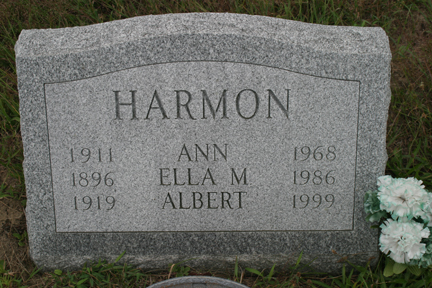
Annabelle’s obituary documents her later family connections and community involvement, although it does not shed light on the circumstances that led to her departure from Harold decades earlier.
What Happened to the Driehorst Family?
The story of Harold and Annabelle Driehorst is difficult to reconstruct because the surviving records offer only fragments of a much larger story.
The newspaper accounts document a family that experienced repeated financial problems, unstable housing, several childhood injuries, and a serious marital breakdown. By 1950, all children were living outside their parents’ household, with the census identifying them as state wards.
These circumstances naturally raise difficult questions about the home in which the children grew up. Was the family overwhelmed by poverty and the pressures of raising six children? Did the conflict between Harold and Annabelle contribute to the children’s separation? Was there a darker side to the household that never made its way into the public record?
The possibility of abuse is one question a researcher might consider when examining this combination of evidence, but the records discussed here do not establish that abuse occurred or that Harold was responsible for the children’s injuries. The circumstances surrounding Annabelle’s departure are also unclear, and Harold’s newspaper statements represent his perspective rather than a complete account of the marriage.
What can be said with greater confidence is that the family endured years of instability and that the children eventually lived apart from their parents. The reasons for that outcome remain incompletely documented.
Harold’s letter to the editor preserves the complaints of a man who felt abandoned by the public assistance system. Annabelle’s departure suggests a marriage in serious difficulty. The census records document the children’s placement in other households, while the later obituaries trace their lives into adulthood.
Each record reveals a piece of the story, but none tells it all.
- National Archives at St. Louis, World War II Draft Registration Cards for New Jersey, 10/16/1940–3/31/1947, Record Group 147, box 178. ↩︎
- Ancestry.com, West Virginia, U.S., Marriages Index, 1785–1971 (Provo, UT: Ancestry.com Operations, Inc., 2011). ↩︎
- Pennsylvania Historical and Museum Commission, Pennsylvania (State) Birth Certificates, 1906 (Harrisburg, PA), box 306, certificate no. [insert certificate number]. ↩︎
- The Daily Notes (Canonsburg, PA), November 18, 1926, Newspapers.com, https://www.newspapers.com/image/53596099/. ↩︎
- The Daily Notes (Canonsburg, PA), August 19, 1927, 1. ↩︎
- National Archives at St. Louis, Post-WWII through Vietnam Era Selective Service Records, New Jersey, Record Group 147, series 147-76-0260. ↩︎
- Fifteenth Census of the United States, 1930, Washington, Washington County, Pennsylvania, page 11B, enumeration district 0118, FamilySearch microfilm 2341898. ↩︎
- “Mary Lucinda Fuller,” Find a Grave, memorial no. 183146350, https://www.findagrave.com/memorial/183146350/mary-lucinda-fuller. ↩︎
- The Morning Post (Camden, NJ), May 27, 1936, 8, Newspapers.com. ↩︎
- The Morning Post (Camden, NJ), March 22, 1939, 4, Newspapers.com. ↩︎
- Evening Courier (Camden, NJ), September 4, 1939, 5, Newspapers.com. ↩︎
- Evening Courier (Camden, NJ), September 12, 1939, 10, Newspapers.com. ↩︎
- The Morning Post (Camden, NJ), June 4, 1940, 4, Newspapers.com. ↩︎
- Sixteenth Census of the United States, 1940, Camden, Camden County, New Jersey, sheet 61A, enumeration district 22-17, roll M-T0627-02393. ↩︎
- Evening Courier (Camden, NJ), May 9, 1940, 10, Newspapers.com. ↩︎
- Evening Courier (Camden, NJ), August 18, 1941, 3, Newspapers.com. ↩︎
- Evening Courier (Camden, NJ), October 31, 1941, 31, Newspapers.com. ↩︎
- Evening Courier (Camden, NJ), July 1, 1949, 3, Newspapers.com. ↩︎
- Seventeenth Census of the United States, 1950, Voorhees, Camden County, New Jersey, page 75, enumeration district 4-201, roll 4737, National Archives and Records Administration, Washington, DC. ↩︎
- Seventeenth Census of the United States, 1950, Waterford, Camden County, New Jersey, page 28, enumeration district 4-203, roll 4737, National Archives and Records Administration, Washington, DC. ↩︎
- National Archives at St. Louis, Records of the Selective Service System, 1926–1975, Record Group 147, Post-WWII through Vietnam Era Selective Service Records, New Jersey, series 147-76-0260. ↩︎
- Woodbury Daily Times (Woodbury, NJ), May 19, 1953, 1, Newspapers.com. ↩︎
- Courier-Post (Camden, NJ), December 12, 1975, 52, Newspapers.com. ↩︎
- “Walter Driehorst,” Find a Grave, memorial no. 318268719, https://www.findagrave.com/memorial/318268719/walter-driehorst. ↩︎
- National Archives at St. Louis, Post-WWII through Vietnam Era Selective Service Records, New Jersey. ↩︎
- “Robert Edward Driehorst,” Find a Grave, memorial no. 318268858, https://www.findagrave.com/memorial/318268858/robert_edward-driehorst. ↩︎
- Woodbury Daily Times (Woodbury, NJ), February 4, 1959, 5, Newspapers.com. ↩︎
- “Dorothy M. Dean,” Find a Grave, memorial no. 100281813, https://www.findagrave.com/memorial/100281813/dorothy-m-dean. ↩︎
- National Archives at St. Louis, Post-WWII through Vietnam Era Selective Service Records, New Jersey. ↩︎
- “James Elmer Driehorst,” Find a Grave, memorial no. 119992038, https://www.findagrave.com/memorial/119992038/james-elmer-driehorst. ↩︎
- National Archives at St. Louis, Post-WWII through Vietnam Era Selective Service Records, New Jersey. ↩︎
- New Jersey State Archives, New Jersey, Death Indexes, 1904–2000 (Trenton, NJ). ↩︎
- National Archives at St. Louis, Post-WWII through Vietnam Era Selective Service Records, New Jersey. ↩︎
- New Jersey State Archives, Marriage Indexes, bride index, 1961, surname range M–Z (Trenton, NJ). ↩︎
- Seventeenth Census of the United States, 1950, Waterford, Camden County, New Jersey, page 28, enumeration district 4-203, roll 4737, National Archives and Records Administration, Washington, DC. ↩︎
- “Harold Wray Driehorst,” Find a Grave, memorial no. 45565090, https://www.findagrave.com/memorial/45565090/harold_wray-driehorst. ↩︎
- “Ann E. Harmon,” Find a Grave, memorial no. 29870381, https://www.findagrave.com/memorial/29870381/ann_e-harmon. ↩︎


Leave a Reply