Part I
The buzz surrounding the “Al G. Barnes’ Animal Circus” began in the spring of 1907 in Kansas. This mesmerizing circus showcased a variety of spectacles, featuring Ruth Grey, heralded as “Nature’s Most Mystic Phenomenon,” during its five-night stint in Topeka, Kansas. The enthralling displays included a remarkable menagerie of jungle actors, showcasing performing wild beasts, ponies, dogs, monkeys, goats, and bears. Admission prices ranged from $.25 to $.50, encompassing matinee shows.

The Topeka Capital-Journal, March 1, 1907
In late February 1907, the circus promoted “Dainty Dolly Castle – The Dancing Girl in the Lion’s Den” in Topeka, with subsequent tragic repercussions. Two weeks later, in Omaha, Nebraska, Dainty Dolly faced a dreadful encounter with one of Al G. Barnes’ Circus lions. The lion, in a terrifying incident, inflicted grave injuries upon Dolly by hurling her against the steel barred arena, resulting in a lacerated scalp and unconsciousness. Despite surviving the ordeal, six months later, Dolly, in a heartfelt statement to her supporters, expressed gratitude for their unwavering kindness, although her left arm never fully recuperated. Dolly Castle passed away in September 1964 in Florida.
Undeterred by adversity, the Al G. Barnes’ Circus pressed on, utilizing Spokane, Washington, as a winter retreat to revitalize. The year 1910 saw the circus embarking on a Canadian tour, expanding its repertoire to encompass 200 trained animals, three steel-girded arenas, and 21 sensational wild animal acts.
Following their seasonal hiatus in California, the Al G. Barnes’ Circus resumed performances in March 1911, commencing in Bakersfield, California. Critics lauded the circus as the “cleanest looking circus outfit ever witnessed,” showcasing the talents of Wallace, the renowned man-killing lion, alongside a diverse array of 200 performing animals. By April 1911, elephants joined the troupe, enhancing the spectacle.
An feature of the Barnes Circus was the grand street parade preceding the main performances, flaunting glittering band chariots, prancing horses, and open dens displaying wild animals. However, mishaps were not unheard of, like the escapade of Barnes’ black bear during a Canadian parade in June 1911, prompting a frantic pursuit through crowds before the bear was eventually secured.

The subsequent years, 1912 and 1913, witnessed the Al G. Barnes’ Circus traversing Canada and various states across America. Tragic events occasionally marred the festivities, as illustrated by an incident in Lawrence, Kansas, in August 1913, where an elephant fatally retaliated against a barking dog during a parade.

By the fall of 1914, the circus ventured southward, debuting in Franklin, Louisiana, and was met with an enthusiastic reception. Amidst their travels in Arizona, an altercation between circus canvasmen culminated in the fatal shooting of well-known Maricopa County Sheriff John C. Power.
The progression of the Barnes Circus, expanding from three rings to four by 1916, showcased an assortment of acts, including juggling seals, performing zebras, baby elephants, Bengal tigers, Indian monkeys, and King Cobra snakes.
The year 1916 unfolded a harrowing event in Waukegan, Illinois, when the lion trainer was fiercely attacked by a lioness. Mable Stark, an experienced member of the Barnes Circus, narrowly escaped serious injury, her prior lion-related injury inadvertently mitigating the extent of the harm.
Subsequently, the Al G. Barnes Circus continued its odyssey through small-town America. Their seasonal tradition of wintering in California before embarking on railcar journeys across the nation was customary. However, unforeseen incidents, such as a lion’s escape during a performance in Montana in July 1919, startled audiences, emphasizing the need for caution during such precarious situations.
The introduction of “Lotus,” a colossal hippopotamus, added a new dimension to the circus’s allure, following an extensive journey from South Africa. The ensuing years marked a focus on the magnificent herd of elephants, with press agents boasting about the unprecedented spectacle of 30 tons of performing elephants and a two-mile pre-performance parade.
As the years unfolded, Al G. Barnes established a winter retreat in Venice, California, encompassing a 120-acre ranch that evolved into “Barnes City,” offering convenient proximity to a nearby railroad for ease of transportation.
In July 1921, the spotlight shone on “Tusko, King of all Elephants,” a colossal pachyderm, standing between eleven-and-a-half to twelve-and-a-half feet tall and insured for $50,000. However, due to his immense size, Tusko was restricted from participating in the pre-performance parades, available for viewing solely at the show grounds.
In August 1922, a disconcerting incident unfolded in South Harrisburg, Pennsylvania, when Tusko broke loose during unloading, causing injuries to a trainer. A strenuous hour-long battle ensued before the elephant was restrained and secured.
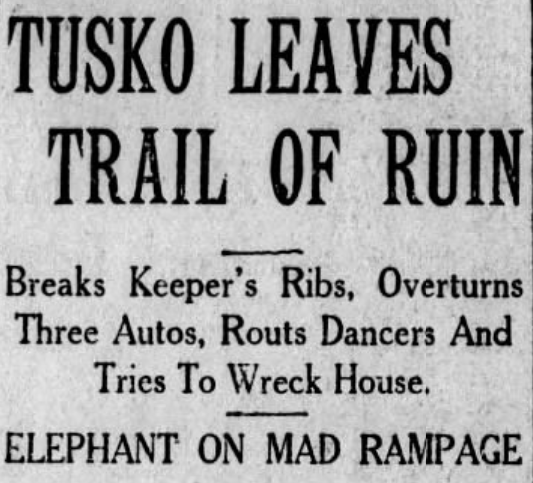
The subsequent years saw Tusko’s erratic behavior, further aggravated by heat in Wilkes-Barre, Pennsylvania, resulting in injuries to a worker and resistance in loading onto the train, prompting concern about his wellbeing. Tragic incidents during the overwintering months in 1925-1926 resulted in charges of animal cruelty against Al G. Barnes and his trainers, linked to Tusko’s confinement and history of erratic behavior.
Tusko continued to tour with the circus, primarily within California, until his sale to Al Painter in 1931. The 1929 circus season unfolded with tours across Oregon, Canada, and the Southern United States. However, a fateful day in Corsicana, Texas, saw the indelible tragedy involving Black Diamond, an elephant with a murky past, resulting in the demise of Eva Donahoo and her handler, H.D. “Curly” Prickett.
The unexpected rampage of Black Diamond during the parade, causing fatal injuries, led to the decision to put the elephant down. The circus continued its performances, but the somber event left an everlasting mark on the town of Corsicana, Texas, immortalized by the tragic demise of Eva Donahoo, remembered at Oakwood Cemetery.

These chronicles depict a tumultuous yet captivating era in the annals of the Al G. Barnes Circus, showcasing both the marvels and tragic episodes that colored its history.
Click here for part II.


Leave a comment